Introduction
In the modern technology landscape, engineering teams often feel like they are spinning multiple plates at once. Application developers push out rapid feature updates, data engineers manage streaming pipelines, data scientists experiment with machine learning models, and security teams monitor compliance frameworks. When these departments operate in silos, friction builds up. A minor change to an infrastructure script can silently break a downstream data model or trigger false-alarm alerts across production systems.
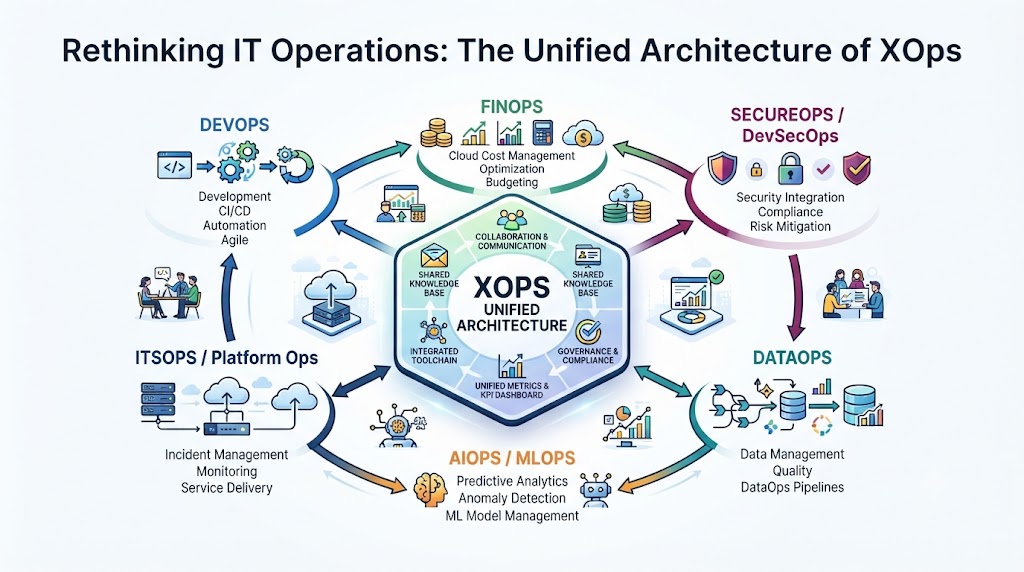
To bridge these gaps, the industry has embraced an overarching operational philosophy known as XOps. Instead of managing software, infrastructure, data, and artificial intelligence as disconnected silos, XOps brings them together through shared automation, observability, and collaborative workflows.
For professionals seeking to master this integrated approach, learning platforms like XOpsSchool offer a structured environment to explore how these different technology domains intersect. Rather than forcing learners to master every tool in total isolation, a connected educational framework demonstrates how automation and continuous delivery unify the entire operational lifecycle.
Understanding the XOps Paradigm
When newcomers enter this field, they frequently ask: What is XOps? At its foundation, XOps is not a single piece of software or a proprietary framework you can install overnight. Instead, it is an umbrella concept where the letter “X” serves as a placeholder for various specialized operational disciplines, including DevOps, DataOps, MLOps, AIOps, SecOps, and FinOps.
These diverse branches share a common set of engineering principles:
- Declarative Infrastructure: Managing cloud environments through code configurations rather than manual point-and-click setups.
- Continuous Integration and Deployment: Automating the transition of code, data updates, and model weights from development to production.
- Centralized Observability: Utilizing unified metrics, logs, and traces to track health across the entire technology stack.
- Proactive Security: Embedding governance and vulnerability checks into daily workflows from day one.
When organizations align around these shared practices, they eliminate traditional handoff delays and build more resilient digital systems.
The Pillars of the XOps Ecosystem
To appreciate how the XOps framework operates in practice, it is helpful to examine the core disciplines that feed into it. Each focus area targets a distinct technical layer while maintaining a commitment to automation and reliability.
DevOps
DevOps connects software development with IT infrastructure operations. It centers on automated testing pipelines, containerization, and reliable code delivery.
DataOps
DataOps applies agile methodologies to data engineering. It focuses on orchestration, automated data quality testing, and continuous delivery so that analytical systems always receive clean, valid information.
MLOps
MLOps handles the complete lifecycle of machine learning. It covers model versioning, automated experiment tracking, and continuous monitoring to catch performance degradation in production environments.
AIOps
AIOps leverages artificial intelligence and machine learning to streamline IT operations. It helps engineers filter through alert noise, spot anomalies early, and automate incident analysis.
SecOps
SecOps weaves security directly into operational pipelines, moving away from isolated annual audits toward continuous compliance and vulnerability mitigation.
FinOps
FinOps brings financial transparency to cloud architecture, enabling cross-functional teams to balance performance needs with cost efficiency.
Platform Engineering
Platform engineering builds internal developer platforms that provide self-service infrastructure, standardizing workflows and reducing cognitive friction for product teams.
| XOps Discipline | Primary Mission | Typical Technical Focus |
| DevOps | Software delivery acceleration | CI/CD, Kubernetes, Docker, Infrastructure as Code |
| DataOps | Reliable data pipeline flow | Orchestration, Data testing, Observability |
| MLOps | Machine learning lifecycle management | Model versioning, Experiment tracking, Monitoring |
| AIOps | Intelligent incident handling | Anomaly detection, Alert correlation, Automation |
| SecOps | Continuous security enforcement | Vulnerability management, Compliance, Access control |
| FinOps | Cloud financial optimization | Cost reporting, Resource budgeting, Efficiency |
| Platform Engineering | Developer self-service enablement | Internal portals, Reusable templates, Standardization |
Structured XOps Training
Pursuing professional XOps Training requires moving beyond single-tool competence and focusing on systems thinking. A comprehensive educational path guides practitioners through cloud fundamentals, container orchestration, pipeline automation, and monitoring strategies.
Educational environments like XOpsSchool help learners understand these systemic relationships, illustrating how an underlying infrastructure issue can directly impact a machine learning inference model or a critical business intelligence pipeline.
Validating Skills Through XOps Certification
Preparing for an XOps Certification provides a structured roadmap for engineers who want to organize their study habits and validate their foundational knowledge. Certification syllabi outline complex architectural concepts, container management strategies, and reliability engineering practices.
However, exams only measure theoretical understanding. True operational expertise is forged through hands-on practice, intentionally breaking configurations in sandbox environments, and troubleshooting live system failures.
Selecting an Effective XOps Course
Choosing the right XOps Course depends on aligning the curriculum with your current technical baseline. A balanced learning journey generally follows a progressive sequence:
- Grasping fundamental operational concepts and cross-domain dependencies.
- Mastering version control and foundational DevOps automation workflows.
- Exploring cloud provisioning, networking basics, and container orchestration.
- Implementing centralized logging, performance metrics, and distributed tracing.
- Expanding into specialized branches like DataOps, MLOps, or AIOps.
- Studying enterprise governance, security policies, and cloud cost optimization.
Learners should choose topics that naturally support their day-to-day engineering responsibilities.
Learning Through a Practical XOps Tutorial
Reading conceptual guides builds a strong baseline, but a hands-on XOps Tutorial turns theory into tangible skill. Practical walkthroughs help engineers understand configuration syntax, pipeline triggers, and monitoring dashboards.
While tutorials offer step-by-step guidance, deep learning happens when you modify example scripts, experiment with edge cases, and adapt workflows to match unique architectural requirements.
Navigating Essential XOps Tools
XOps is not a packaged product you can buy off the shelf; it is implemented using a rich ecosystem of modern technologies:
- Source Control: Git, GitHub, and GitLab for collaborative version tracking.
- CI/CD Platforms: GitHub Actions, Jenkins, and GitLab CI for automated build pipelines.
- Containers and Orchestration: Docker for packaging applications and Kubernetes for scaling them.
- Infrastructure Automation: Terraform and Ansible for declarative environment provisioning.
- Observability Stacks: Prometheus, Grafana, and OpenTelemetry for metrics, logs, and traces.
- GitOps Engines: Argo CD and Flux for declarative state synchronization.
Tool selection should always be dictated by team capability, scale, and security constraints rather than industry hype.
DevOps Training
Establishing strong DevOps Training habits serves as the gateway to the broader XOps landscape. Learning source control, automated testing, and container deployment equips engineers with the foundational language required to manage complex, multi-layered environments.
AIOps Training
Targeted AIOps Training teaches teams how to harness data analytics to cut through alert fatigue. By studying automated anomaly detection and event correlation, operations teams can maintain high availability across distributed architectures.
MLOps Training
Engaging in MLOps Training connects data science experimentation with dependable software engineering. Learners discover how to package predictive models into reliable containers, track data drift, and automate continuous retraining cycles.
DataOps Training
Specialized DataOps Training helps data engineers treat information pipelines with the same engineering rigor software developers apply to application code. Key focus areas include schema validation, automated data testing, and end-to-end monitoring.
| Learning Goal | Recommended XOps Area | Skills to Develop |
| Application delivery | DevOps | CI/CD pipelines, Containerization, Git workflows |
| Cloud infrastructure | Platform Engineering / DevOps | Infrastructure as Code, Cloud provisioning, Networking |
| Data pipelines | DataOps | Data orchestration, Quality testing, Observability |
| Machine-learning deployment | MLOps | Model versioning, Experiment tracking, Monitoring |
| Intelligent operations | AIOps | Anomaly detection, Alert correlation, Automation |
| Reliability engineering | Observability & SRE | Metrics collection, Logging, Incident management |
How Interconnected Disciplines Support Each Other
The true value of XOps becomes clear when you observe how individual domains reinforce one another. DevOps ensures application code moves safely into production. DataOps supplies clean, reliable data streams. MLOps keeps predictive models accurate over time. AIOps monitors the health of this entire digital ecosystem, spotting anomalies before users experience downtime.
Sharing observability tools and automation patterns prevents these teams from drifting back into isolated operational silos.
Who Benefits Most from XOpsSchool?
DevOps and Cloud Engineers
Engineers looking to expand their skill sets beyond traditional infrastructure can learn how AI and data workflows integrate seamlessly into cloud-native environments.
Data Engineers
Data professionals can adopt DataOps principles to automate quality validation and build resilient, self-healing data pipelines.
Machine Learning Professionals
Data scientists can utilize MLOps concepts to transition experimental notebooks into robust, production-ready services.
IT Operations and SRE Professionals
Site reliability engineers can blend observability, automation, and AIOps practices to minimize downtime and speed up incident resolution.
Developers and Technical Learners
Software developers can gain a deeper appreciation of production environments, writing cleaner, more resilient applications from the start.
Technology Teams and Organizations
Engineering leaders can leverage cross-functional XOps knowledge to align team workflows and remove systemic organizational bottlenecks.
Common Traps to Avoid When Learning XOps
- Treating XOps as software: Believing that XOps is a standalone application you can purchase and install.
- Skipping foundational knowledge: Jumping straight into advanced MLOps or AIOps without mastering basic Linux, networking, and version control.
- Ignoring observability: Automating rapid deployments without establishing proper logging and metric tracking.
- Chasing shiny tools: Adopting complex technologies simply because they are trendy rather than evaluating genuine architectural needs.
Best Practices for Your Learning Journey
- Master the fundamentals first: Secure a solid grasp of version control, cloud fundamentals, and basic automation before tackling specialized domains.
- Build integrated projects: Avoid studying concepts in total isolation; combine infrastructure, monitoring, and data pipelines into small sandbox projects.
- Prioritize concepts over syntax: Remember that command-line flags and tool syntax change over time, but core automation principles remain constant.
- Document your hurdles: Keep notes on troubleshooting steps when configurations break; it creates a valuable personal knowledge base.
Your 8-Step XOps Roadmap
- Grasp XOps Fundamentals: Understand how cross-functional operational philosophies streamline modern software delivery.
- Establish DevOps Roots: Master version control, basic CI/CD workflows, and containerization.
- Study Cloud Infrastructure: Learn cloud computing fundamentals, networking basics, and Infrastructure as Code.
- Master Observability: Implement metrics collection, distributed logging, and incident tracking.
- Explore DataOps: Learn pipeline orchestration, automated testing, and continuous data delivery.
- Investigate MLOps and AIOps: Understand model deployment lifecycles and AI-driven operational monitoring.
- Incorporate Security and FinOps: Study continuous compliance checking and cloud cost management principles.
- Build a Capstone Project: Combine multiple operational disciplines into a single integrated sandbox environment.
Frequently Asked Questions
What is XOps in simple terms?
XOps is an umbrella framework that unites various IT operational disciplines—such as DevOps, DataOps, and MLOps—under a shared culture of automation, collaboration, and reliability.
How does XOps differ from traditional DevOps?
While DevOps focuses primarily on application delivery and infrastructure automation, XOps expands that mindset to encompass data pipelines, machine learning models, security operations, and AI-driven monitoring.
What specific disciplines fall under the XOps umbrella?
Commonly included fields are DevOps, DataOps, MLOps, AIOps, SecOps, FinOps, and Platform Engineering.
Is XOps approachable for total beginners?
Yes, beginners can start by mastering fundamental cloud and DevOps concepts before gradually exploring specialized operational branches.
What topics should an effective XOps learning path cover?
A comprehensive training program should touch on cloud infrastructure, automation scripts, CI/CD pipelines, observability, data flows, and machine learning lifecycles.
Why do people pursue XOps certification?
Certifications help structured learners organize complex technical subject matter and provide a baseline validation of their conceptual understanding.
What makes a good XOps course?
Look for courses that emphasize core principles, logical progression, and practical problem-solving rather than focusing exclusively on specific commercial tools.
Which tools appear most frequently in XOps workflows?
Frequently used technologies include Git, GitHub Actions, Docker, Kubernetes, Terraform, Ansible, Prometheus, and Grafana.
How do DevOps, DataOps, MLOps, and AIOps stay linked?
They share underlying automation frameworks, CI/CD design patterns, foundational infrastructure, and centralized observability platforms.
What is the best way to begin learning XOps?
Start by understanding core XOps principles, build strong DevOps foundations, and gradually explore adjacent operational domains using structured platforms like XOpsSchool.
Conclusion
Building modern technology requires looking past narrow technical specializations. As cloud infrastructure, software, data streams, and artificial intelligence become deeply intertwined, adopting a connected operational strategy is essential. XOps supplies the overarching framework needed to dissolve departmental silos, standardize automation, and boost overall reliability. By leaning on educational resources like XOpsSchool, technology professionals can systematically acquire the versatile skillset needed to thrive in today’s complex ecosystem.