
Introduction
Knee replacement surgery can help people living with severe joint damage, structural bone wear, and ongoing pain. Making the choice to have surgery is a big health decision. Patients should understand the full procedure, potential risks, and long-term commitments before deciding on care.
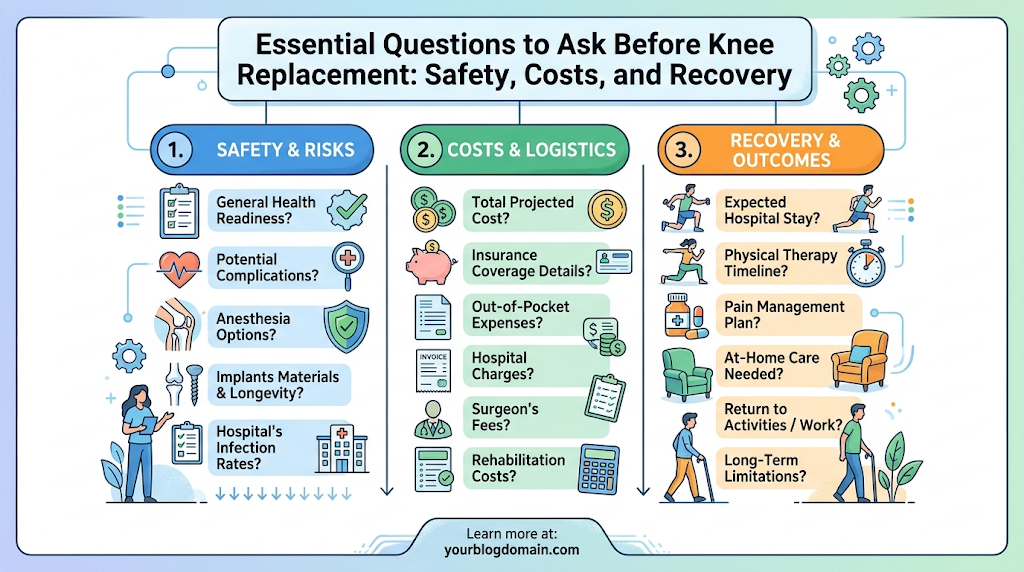
Asking clear questions helps you learn about alternative treatment choices, surgical risks, and modern technology options. You can also discuss implant materials, total expenses, hospital stays, and your home recovery path. Talking openly with an orthopaedic surgeon helps you understand what to expect before, during, and after surgery. Good preparation allows you to make safe, confident, and well-informed choices for your health.
Understanding Knee Replacement Surgery
The knee joint is the largest joint in the human body, connecting your thighbone (femur) to your shinbone (tibia), with the kneecap (patella) sitting over the front. Smooth, slippery tissue called articular cartilage covers these bone ends so they can glide easily without friction during movement.
Severe osteoarthritis, inflammatory rheumatoid arthritis, or traumatic injuries can wear away this protective cartilage over time. When cartilage disintegrates completely, raw bone surfaces rub directly against each other. This friction causes chronic inflammation, bone spurs, severe stiffness, and joint deformity.
Knee replacement surgery, medically known as knee arthroplasty, removes the damaged bone ends and worn cartilage. The surgeon resurfaces the joint with durable metal and high-density plastic components. The primary goal is to reduce long-term joint pain, correct leg alignment, and help you regain comfortable movement in daily life.
When Should Patients Consider Knee Replacement Surgery?
Doctors usually suggest surgery when severe knee damage stops you from enjoying daily life and non-surgical remedies fail.
- You experience ongoing, severe knee pain that limits your ability to walk or stand.
- Advanced osteoarthritis causes grinding sensations, stiffness, and joint deformity.
- Chronic rheumatoid arthritis causes persistent swelling and progressive joint breakdown.
- A past traumatic injury or fracture leaves your knee joint unstable or misaligned.
- Simple tasks like walking, climbing stairs, or getting out of a chair become very hard.
- Deep joint pain persists even while resting or wakes you up during the night.
- You can no longer manage basic household chores, job duties, or social activities.
- Prescription medicines, physical therapy, and joint injections no longer offer pain relief.
Doctors carefully review your daily symptoms, physical mobility exams, weight-bearing X-rays, magnetic resonance imaging (MRI) scans, and general medical history before suggesting an operation. Having knee pain alone does not always mean you need surgery right away.
Questions About the Need for Knee Replacement
You should understand the exact clinical reasons why a doctor recommends an operation for your knee.
- Why do I need knee replacement surgery at this point in my care?
- How much cartilage damage and bone wear has occurred inside my joint?
- Is my current bone structure and joint alignment suitable for an operation?
- Are there any other non-surgical care options I should try first?
- What might happen to my joint function and bone health if I delay surgery?
- How much improvement in daily movement and pain relief can I reasonably expect?
- Is now the best time for me to have this surgery based on my age and health?
Understanding both surgical and non-surgical choices helps you weigh the benefits against potential risks.
Questions About Alternative Treatment Options
Before choosing surgery, doctors usually recommend exploring non-surgical care paths to manage joint pain. Dedicated physical therapy can strengthen the quadriceps and hamstring muscles that stabilize your knee joint.
Weight management reduces the structural pressure placed on your weight-bearing leg joints; every pound of body weight lost removes roughly four pounds of pressure from the knees. Walking aids like canes or walkers can take stress off the joint during flare-ups. Doctors may also suggest supportive knee braces or targeted joint injections—such as corticosteroid or hyaluronic acid injections—to lower localized swelling and ease pain.
Ask your doctor if physical therapy routines or lifestyle adjustments can still improve your mobility. Inquire about the benefits and limitations of each non-surgical path. The right choice depends on the underlying cause, location, and total severity of your knee damage.
Questions About the Surgeon’s Experience
A surgeon’s specialized training, case volume, and everyday practice matter significantly for your joint care outcome.
- Are you fellowship-trained in adult joint reconstruction and knee replacement?
- How many knee replacement procedures do you perform each year?
- Do you treat many patients with complex conditions or health histories like mine?
- Which surgical approach and incision technique do you recommend for my joint?
- What specific complications should I understand based on my medical background?
- Who will manage my day-to-day medical care while I rest in the hospital?
- Can you explain your overall patient success rate and clinical background with this operation?
You can verify surgical credentials through official medical licensing boards and professional orthopaedic associations online. Keep in mind that while surgeon experience is crucial, it cannot guarantee a specific surgical outcome for every single patient.
Questions About the Type of Knee Replacement
Surgeons choose different procedure types based on the location and extent of your joint damage.
Total Knee Replacement
In a total knee replacement, the surgeon replaces worn joint surfaces across all three compartments of the knee—the inner side, outer side, and under the kneecap—using metal caps and a plastic spacer.
Partial Knee Replacement
A partial (unicondylar) knee replacement replaces only one damaged compartment of the joint, leaving healthy bone, cartilage, and ligaments (like the ACL) intact. Surgeons recommend this less invasive option for select patients with localized damage.
Revision Knee Replacement
Revision surgery repairs or replaces artificial parts from a previous knee implant that have worn down, loosened, or developed an infection over many years of use.
Ask your surgeon which procedure type fits your specific joint damage and why. Inquire if a partial replacement is an option for your knee, and ask whether you might require a revision operation later in life.
Questions About Surgical Methods and Technology
Surgeons can utilize various surgical techniques, alignment approaches, and technological tools during an operation. Traditional knee replacement relies on manual alignment guides, cutting jigs, and visual checks by the surgeon.
Some modern clinics offer computer-guided navigation systems or robotic-assisted surgical equipment to help plan bone cuts and position implants with high precision based on 3D models. Technology can assist the surgeon in balancing soft tissues, but it does not automatically guarantee better long-term results for every single patient.
Ask your doctor which surgical method they plan to use for your procedure and why. Find out if robotic assistance or custom instruments change your safety profile, incision length, or overall recovery timeline. Your surgeon should explain why a specific surgical approach fits your unique body.
Questions About Knee Implants
An artificial knee implant, or prosthesis, replaces damaged bone and cartilage surfaces. Modern implants are made from durable biocompatible metals—such as cobalt-chromium, titanium, or zirconium alloys—and smooth medical-grade polyethylene plastic.
Surgeons match the implant design, sizing system, and fixation method (cemented vs. press-fit bone ingrowth) to your age, activity level, and bone shape. Ask your surgeon which specific implant brand and material combination they recommend for your knee.
Inquire why that specific design fits your bone structure and physical demands. Ask how many years the implant is expected to perform and whether you will need regular check-ups to monitor mechanical wear over time.
Questions About Surgical Risks and Safety
Like any major surgical procedure, knee replacement carries potential health risks that you should discuss beforehand.
- Superficial wound infection or deep joint infection around the implant.
- Blood clots forming in deep leg veins (deep vein thrombosis) or traveling to the lungs (pulmonary embolism).
- Unexpected bleeding or fluid buildup around the surgical site.
- Joint stiffness, scar tissue buildup (arthrofibrosis), or loss of full bend and straighten motion.
- Irritation or injury to nearby nerves or blood vessels.
- Mechanical loosening, shifting, or surface wear of artificial parts over time.
- Persistent joint discomfort or localized kneecap pain after healing.
- Delayed wound healing or skin margin breakdown near the surgical cut.
Ask your doctor which specific risks apply to your personal medical history. Inquire how their surgical team prevents infections and blood clots, and ask how your post-surgery pain will be safely managed.
Questions About Medical Tests Before Surgery
Your healthcare team conducts thorough medical tests to ensure your body can safely handle anesthesia and surgery.
- Complete blood count (CBC), kidney function, liver panels, and blood clotting tests.
- Weight-bearing knee X-rays and imaging scans to map exact bone loss and joint angles.
- Heart checks like an electrocardiogram (ECG) or echocardiogram to confirm cardiac fitness.
- Comprehensive review of all daily prescription medications, over-the-counter drugs, and herbal supplements.
- Screening for active infections in your skin, teeth, or urinary tract.
- Anesthesia health consultations to choose safe pain management strategies.
Ask which specific medical tests you must complete before your surgery date. Confirm if pre-existing conditions like diabetes or high blood pressure are properly controlled, and ask which medicines you must pause before your operation.
Questions About Anesthesia and Pain Control
Anesthesia keeps you safe, calm, and pain-free throughout your operation. General anesthesia keeps you completely asleep during the entire procedure using intravenous drugs and inhaled gases.
Regional anesthesia—such as a spinal or epidural block—numbs your body from the waist down while keeping you relaxed under light sedation. Modern clinics often add targeted nerve blocks (like an adductor canal block) around the knee to manage early pain. Ask your medical team which type of anesthesia fits your health status and who will monitor you.
Inquire about common side effects like nausea or drowsiness as the medicine wears off. Ask how your care team will adjust pain medications to keep you comfortable right after waking up.
Questions About Surgery Costs and Hospital Charges
Surgical expenses vary significantly based on hospital selection, surgical technology, implant materials, and total care needs.
Ask your hospital for a clear, written cost outline before your admission date. Inquire about primary surgeon fees, assistant surgeon charges, anesthesiology fees, implant pricing, and daily room categories.
Confirm whether pre-surgery laboratory tests, post-op prescription drugs, inpatient physical therapy, and initial follow-up visits are included in the quote. Ask what additional charges might apply if you require extra hospital days, special ICU monitoring, or unexpected care for complications.
Important Questions Before Knee Replacement
| Topic | Questions Patients Should Ask | Why It Matters |
| Need for surgery | Is knee replacement the right choice for me? | Helps understand the clinical reason for surgery |
| Other treatments | Are non-surgical options still suitable for my joint? | Helps compare available non-surgical choices |
| Surgeon experience | How often do you perform this specific procedure? | Helps patients understand relevant surgical expertise |
| Implant | Which implant material and design will you use? | Explains the artificial joint components and durability |
| Safety | What specific risks apply to my health history? | Helps patients prepare for complications and safety steps |
| Anesthesia | Which type of anesthesia will I receive? | Explains the surgical process and pain relief plan |
| Cost | What items does the total price estimate cover? | Helps with financial planning and avoiding surprise fees |
| Recovery | How long will my full recovery path take? | Helps set realistic expectations for daily milestones |
| Follow-up | Which long-term check-ups will I need? | Supports proper ongoing joint monitoring and care |
Questions About Hospital Stay and Care After Surgery
Knowing what happens during your hospital stay helps you prepare mentally for your immediate recovery.
- How many days will I stay in the hospital before discharge?
- How soon after my operation will I start standing and taking steps?
- Will a physical therapist guide my daily exercises in the hospital room?
- What nursing support and wound monitoring will I receive during my stay?
- Can I return straight home, or will I need a stay at a rehabilitation center?
- Will I need a family member or hired caregiver to assist me at home initially?
Most patients stand and take short steps using a walker or crutches within 24 hours after surgery under physical therapy supervision. Your exact discharge date depends on your pain control, ability to walk safely, and overall medical stability.
Questions About Recovery and Physiotherapy
Healing from joint surgery takes time, patience, and active effort. Physical therapy is essential for rebuilding quadriceps strength, reducing swelling, and restoring your knee’s range of motion.
Ask your doctor how long your full recovery path might take to reach your personal goals. Inquire when you can safely transition from a walker to a cane, and eventually to walking unassisted.
Ask how many weeks of formal physical therapy sessions you will need and when you can safely climb stairs, drive a car, or return to work. Everyone heals at their own pace, so avoid comparing your progress strictly to others.
Questions About Home Preparation and Daily Support
Modifying your home before surgery makes your return from the hospital safer and much easier.
Remove loose throw rugs, floor mats, clutter, and electrical cords from all main walkways. Keep daily items like medicines, phones, and snacks within easy reach so you avoid deep bending or reaching.
Set up a safe sleeping area on the ground floor if climbing stairs is difficult early on. Install sturdy grab bars and place a raised seat in your bathroom for extra support. Arrange for a family member or friend to help with cooking, cleaning, heavy lifting, and travel to appointments during the first few weeks.
Preparation Before Surgery
| Preparation Area | What Patients Should Discuss |
| Medical history | Share existing health conditions, allergies, and previous operations |
| Medicines | Review all prescription drugs, blood thinners, and daily supplements |
| Health checks | Complete all pre-operative blood work, ECGs, and scans advised by the team |
| Physical preparation | Ask about safe pre-hab exercises to build muscle before surgery |
| Home setup | Arrange clear walkways, bathroom safety features, and a recovery area |
| Hospital planning | Confirm exact admission times, required documents, and expected stay length |
| Recovery support | Arrange for reliable transportation and family caregiving assistance at home |
Questions About Long-Term Results and Follow-Up Care
Ongoing follow-up care helps protect your artificial joint and ensures long-term comfort.
- How often will I need routine follow-up check-ups and X-rays with your clinic?
- How many years can I expect my new artificial knee joint to perform well?
- Which physical activities, sports, and exercises are safe for my artificial joint?
- Is it safe for me to kneel on my operated knee after it heals?
- Which warning signs or red-flag symptoms should I report to your clinic right away?
- What steps happen if the artificial implant loosens or wears out later in life?
Routine follow-up visits allow your orthopaedic surgeon to monitor your joint alignment, evaluate plastic spacer wear, and catch any minor joint changes early.
Practical Checklist Before Knee Replacement Surgery
Use this practical list to prepare for your surgical consultation:
- Understand the exact clinical reason why knee surgery is recommended.
- Ask if any non-surgical care options are still worth trying first.
- Check your surgeon’s background, qualifications, and procedure volume.
- Learn whether total or partial knee replacement fits your condition.
- Understand the specific implant design, materials, and fixation chosen.
- Talk through potential surgical risks based on your health history.
- Complete all required pre-surgery blood work, cardiac checks, and scans.
- Discuss anesthesia options and post-surgery pain control strategies.
- Request a detailed, written price estimate for the procedure and stay.
- Confirm your expected length of stay in the hospital before discharge.
- Set up your physical therapy schedule and rehabilitation plan early.
- Modify your home layout for safe movement and fall prevention.
- Schedule your post-surgery check-up appointments with your surgeon.
How KneeHospitals Can Help Patients Understand Knee Care
KneeHospitals provides clear, reliable health resources to help patients understand joint conditions, surgical paths, implant materials, and recovery expectations. Access to accurate medical information makes it much easier to prepare for important conversations with your clinical team.
Reviewing simple educational guides helps you write down meaningful questions for your orthopaedic surgeon. When severe joint pain limits your daily life and mobility, consulting a qualified orthopaedic specialist is the best step toward finding lasting relief and regaining your independence.
Frequently Asked Questions (FAQs)
What should I ask my doctor before knee replacement surgery? You should ask about the need for surgery, non-surgical alternatives, surgical risks, implant choices, total expenses, expected hospital stays, physical therapy plans, and long-term recovery goals.
How do I know if I need knee replacement surgery? You may need surgery if severe knee pain, stiffness, and joint damage stop you from walking or doing daily tasks, and non-surgical treatments no longer offer relief.
Are there alternatives to knee replacement surgery? Yes, non-surgical alternatives include dedicated physical therapy, anti-inflammatory medicines, lifestyle adjustments, weight management, walking aids, supportive braces, and joint injections.
What is the difference between total and partial knee replacement? Total knee replacement replaces all worn joint surfaces across the knee, while partial knee replacement replaces only the single damaged compartment of the knee joint.
Which implant is used in knee replacement surgery? Surgeons use artificial implants made of durable biocompatible metal components (like cobalt-chrome or titanium) and medical-grade plastic spacers to recreate smooth joint movement.
What are the common risks of knee replacement surgery? Potential risks include wound infection, blood clots in leg veins, joint stiffness, scar tissue buildup, nerve irritation, unexpected bleeding, and long-term mechanical implant wear.
What tests are needed before knee replacement? Pre-surgery tests usually include complete blood work, weight-bearing knee X-rays, cardiac checks like an ECG, urine screens, and general health reviews by an anesthesia team.
How long does recovery after knee replacement take? Initial healing takes about 4 to 6 weeks for basic daily movement and light tasks, while full muscle strength, balance, and maximum joint flexibility build over 6 to 12 months.
When can I walk after knee replacement surgery? Most patients stand and take short steps with a walker or crutches within 24 hours after surgery under physical therapy guidance and pain management.
How long can a knee replacement implant last? Many modern artificial knee joints last between 15 and 20 years or more, depending on your physical activity levels, body weight, implant design, and overall joint care.
Conclusion
Asking the right questions before knee replacement surgery helps you take active control of your health journey. Learning about surgical methods, implant materials, total costs, safety steps, and recovery expectations allows you to prepare with confidence.
Every patient has unique health needs and lifestyle goals, so discuss your symptoms openly with a qualified orthopaedic surgeon. Proper preparation leads to safe medical decisions, realistic expectations, and a smoother path toward long-term mobility.