Introduction
Experiencing knee pain can affect walking, movement, work, sleep, and everyday activities. Whether it starts slowly or happens after a sudden twist or fall, knee pain can make simple daily tasks difficult.
Imagine waking up every morning with a persistent ache or stiffness in your knee. You try to adjust your daily routine, but climbing stairs or getting out of a car becomes uncomfortable. You find yourself wondering what is causing the discomfort, whether it will go away on its own, and where you should go to find reliable medical advice.
Because knee pain can have many different causes, treatment differs from patient to patient. A professional medical evaluation is essential to understand the root cause of the problem. Choosing a suitable hospital and an experienced specialist helps ensure you receive accurate guidance. Understanding your treatment choices before making decisions and planning for recovery are vital parts of the healthcare journey.
Resources like KneeHospitals.com can help readers research knee healthcare options, explore orthopedic hospitals, and learn more about treatment planning.
Featured Snippet
What Are Common Treatments for Knee Pain?
Treatment for knee pain may include activity changes, physical therapy, prescribed medicines, weight management, assistive support, injections in selected cases, and rehabilitation. For certain conditions, surgery such as knee replacement may be considered. Treatment always depends on the underlying cause, severity, overall health, and individual patient needs.
Understanding Knee Pain
What Is Knee Pain?
Knee pain refers to any discomfort felt in or around the knee joint. The knee is a complex structure involving bones, muscles, tendons, ligaments, cartilage, and surrounding tissues. Pain may be felt directly in the joint, behind the kneecap, or along the sides of the leg. The exact location of the pain does not always reveal its exact cause, which is why proper medical assessment is important.
Common Causes of Knee Pain
Knee pain can arise from several factors, including:
- Osteoarthritis and age-related wear and tear
- Sports injuries or sudden trauma
- Ligament injuries (such as ACL or MCL tears)
- Meniscus tears in the knee cartilage
- Tendon problems or tendinitis
- Bursitis (inflammation of fluid sacs around the joint)
- Stress fractures or traumatic fractures
- Overuse from physical activity or repetitive strain
- Certain inflammatory joint conditions
Medical professionals evaluate these possibilities during an examination.
When Should Someone Seek Medical Advice for Knee Pain?
It is wise to seek medical advice if knee pain continues, keeps returning, or interferes with normal daily activities. You should consider seeing a healthcare professional promptly if you experience:
- Severe pain that makes walking difficult or impossible
- Inability to put weight on the affected leg
- Noticeable swelling, warmth, or redness around the joint
- Symptoms that follow a fall, sports injury, or significant impact
- The knee locking, catching, or feeling unstable
- Pain that disrupts sleep or does not improve with rest
How Hospitals Evaluate Knee Pain
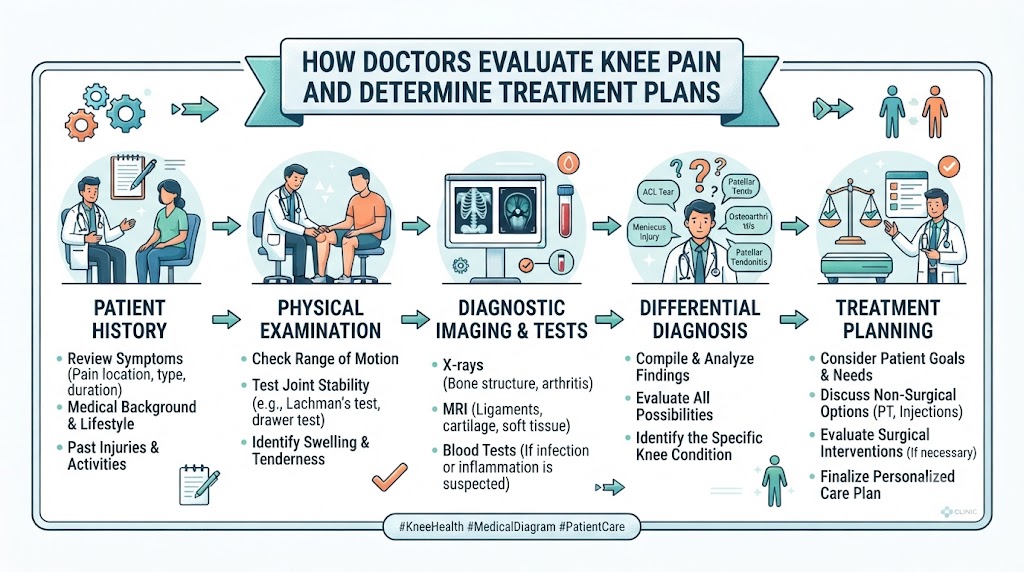
Medical evaluation usually begins with a thorough review of your medical history and a discussion of your symptoms. The doctor will perform a physical examination to check your range of motion, joint stability, strength, and tenderness around the knee.
If necessary, the doctor may recommend imaging tests to get a clearer view of the bones and soft tissues. Not every patient requires every test, and the evaluation is tailored to each individual’s symptoms.
Common Tests for Knee Problems
- X-Ray: Uses low-dose radiation to create images of bones, helping doctors spot signs of arthritis, fractures, or joint space narrowing.
- MRI: Uses magnetic fields and radio waves to produce detailed images of soft tissues, including ligaments, cartilage, and tendons.
- CT Scan: Provides cross-sectional images of bone structures and joint alignment when detailed visualization is needed.
- Other Tests: Additional blood work or specialized assessments may be considered if an infection or inflammatory condition is suspected.
Types of Knee Pain Treatment
Non-Surgical Knee Pain Treatment
Many patients find relief through non-surgical approaches. Doctors often recommend starting with conservative care unless immediate surgery is necessary. Common non-surgical options include:
- Physical Therapy: Guided exercises to strengthen supporting muscles and improve flexibility.
- Activity Changes: Modifying activities or sports that trigger or worsen pain.
- Weight Management: Reducing excess load on the knee joint where appropriate.
- Assistive Devices: Using braces, canes, or wraps temporarily to reduce pressure on the knee.
Physical Therapy and Rehabilitation
Physical therapy plays a central role in knee care. Guided movement helps restore muscle strength, improve joint stability, and enhance overall mobility. Following a professional physical therapy plan tailored to your condition is essential for safe recovery.
Medicines for Knee Pain
Healthcare professionals may recommend medicines to help manage pain and inflammation. These can include over-the-counter pain relievers or prescription anti-inflammatory drugs. Patients should always use medications as directed by a qualified professional and avoid self-prescribing.
Injections for Knee Pain
In selected cases, doctors may consider localized injections, such as corticosteroids or viscosupplementation, to help reduce inflammation and improve joint lubrication. Injections are not suitable for every patient and are usually part of a broader treatment plan.
When Is Knee Surgery Considered?
Surgery may be considered when non-surgical treatments do not provide sufficient relief, or when structural damage to the joint or ligaments requires a surgical solution. Doctors evaluate numerous factors, including the underlying condition, symptom severity, imaging results, and overall health. Not everyone with knee pain needs surgery.
Knee Replacement Surgery
Knee replacement surgery involves removing damaged bone and cartilage from the knee joint and replacing them with artificial metal and plastic components. This procedure is typically considered for advanced joint damage that severely impacts daily life and mobility. Surgery requires careful evaluation by an orthopedic specialist and a structured recovery plan.
Other Knee Procedures
Other surgical options include knee arthroscopy, which uses small incisions and a camera to repair meniscus tears or clean up joint debris, ligament repair or reconstruction surgeries, and fracture-related procedures. The appropriate procedure depends entirely on the patient’s unique diagnosis.
Knee Treatment Comparison Table
| Treatment Approach | What It Generally Involves | When It May Be Considered |
| Physical therapy | Guided movement, strength, and flexibility work | Many knee and movement problems |
| Activity changes | Adjusting activities that worsen symptoms | Depending on the cause |
| Medicines | Medicines recommended by a healthcare professional | Selected patients |
| Injections | Medicine delivered to a targeted area | Certain conditions |
| Knee surgery | Surgical treatment for selected problems | When clinically appropriate |
| Knee replacement | Replacing damaged parts of the joint | Certain advanced knee conditions |
Treatment choices depend on clinical evaluation and personal health factors. No single treatment is right for every patient.
How to Choose a Top Knee Hospital
Finding a suitable hospital involves looking beyond general reputation and focusing on specific clinical strengths. Patients can evaluate:
- Experience With Knee Conditions: Check if the hospital regularly treats your specific knee diagnosis.
- Knee Specialists: Review the qualifications, orthopedic sub-specialties, and clinical experience of the doctors.
- Hospital Facilities: Confirm the availability of advanced diagnostic imaging, surgical suites, and dedicated orthopedic care units.
- Rehabilitation Services: Look for comprehensive physical therapy and post-operative recovery support.
- Quality and Credentials: Review recognized hospital accreditations and safety standards.
- Patient Support: Check appointment coordination, communication standards, and international patient assistance where applicable.
How to Choose the Right Knee Specialist
Selecting an orthopedic specialist requires looking at their medical credentials, board certifications, and specific experience with knee disorders. During your consultation, pay attention to how clearly the specialist explains your condition, listens to your questions, and outlines potential treatment paths. A good specialist works collaboratively with you to design a care plan suited to your lifestyle and health needs.
Questions to Ask a Knee Specialist
- What may be causing my knee pain?
- What diagnostic tests may I need?
- What non-surgical treatment options are available?
- Why might surgery be recommended for my condition?
- Are there alternative treatment approaches we should try first?
- What are the possible risks and benefits of the proposed treatment?
- How long may recovery take after treatment or surgery?
- What type of physical therapy and rehabilitation will I need?
- What follow-up care schedule should I expect?
How Much Does Knee Pain Treatment Cost?
Costs vary depending on the treatment, hospital, specialist, location, and individual patient requirements. Expenses may include diagnostic testing, specialist consultations, surgical procedures, hospital stays, implant devices, rehabilitation sessions, medications, and follow-up appointments. Requesting itemized estimates helps patients plan their healthcare finances clearly.
Knee Treatment for International Patients
International patients traveling for knee care should organize their medical history, previous X-rays, and MRI scans for secure transfer. Online tele-consultations can help establish contact with foreign specialists before travel. Patients must coordinate hospital admission, travel visas, local accommodation, and long-term follow-up care with their home physicians to ensure a smooth transition.
Why Recovery and Follow-Up Care Matter
Recovery requires patience, adherence to physical therapy, and consistent follow-up appointments with your medical team. Proper rehabilitation helps restore muscle strength and joint flexibility. Patients should discuss activity restrictions, medication schedules, and communication channels with their healthcare providers before leaving the medical facility.
Common Mistakes Patients Make When Seeking Knee Treatment
- Choosing Only by Price: Selecting a medical center based solely on cost rather than clinical quality and specialist expertise.
- Ignoring Specialist Experience: Failing to verify whether the treating physician specializes in knee care.
- Assuming Surgery Is Always Needed: Believing that all knee pain requires an operation when many cases respond well to non-surgical care.
- Ignoring Rehabilitation: Skipping physical therapy or failing to follow structured post-treatment recovery guidelines.
- Trusting Every Online Ranking: Relying on unverified online lists rather than checking legitimate hospital accreditations.
- Not Asking About the Full Cost: Overlooking potential secondary expenses related to rehabilitation and follow-up visits.
- Believing Guaranteed Results: Expecting absolute outcomes or guaranteed pain relief from medical procedures.
Knee Pain Treatment Checklist
- Understand your symptoms and when they occur
- Speak with a qualified healthcare professional
- Bring previous medical records and imaging files
- Review available test results with your doctor
- Research suitable knee hospitals and orthopedic centers
- Check specialist qualifications and experience
- Ask about both surgical and non-surgical treatment choices
- Understand possible risks and side effects
- Ask about expected recovery timelines
- Discuss treatment costs and financial planning
- Confirm rehabilitation and physical therapy requirements
- Schedule and confirm follow-up care arrangements
How KneeHospitals.com Can Help Patients
KneeHospitals.com serves as an educational informational resource designed to help patients and families research knee hospitals and orthopedic care options. The platform provides helpful guides covering knee treatment overviews, hospital information, and specialist details.
While KneeHospitals.com helps users explore healthcare options, it does not provide medical diagnoses, guarantee treatment outcomes, promise cures, or guarantee hospital admissions. All medical decisions should be made in direct consultation with qualified healthcare professionals. Hospital services vary and should be independently verified.
Real-World Patient Scenarios
Patient With Long-Term Knee Pain
- Challenge: David experienced persistent aching in his knee that gradually worsened during daily walks.
- Research Process: He used online healthcare guides to understand diagnostic steps and gathered his medical history.
- Decision Factors: He consulted an orthopedic specialist for a physical evaluation and diagnostic X-rays.
- Planning Considerations: David started a tailored non-surgical physical therapy program to manage his symptoms.
Patient With Knee Arthritis
- Challenge: Sarah struggled with stiffness and pain caused by knee osteoarthritis affecting her mobility.
- Research Process: She researched non-surgical management options and specialist credentials.
- Decision Factors: She discussed lifestyle adjustments, weight management, and targeted physical therapy with her doctor.
- Planning Considerations: Sarah arranged for regular follow-up visits to monitor her joint function over time.
Patient Considering Knee Replacement
- Challenge: Michael faced advanced knee joint damage that severely limited his daily independence.
- Research Process: He compared orthopedic hospital surgical experience and rehabilitation facilities.
- Decision Factors: He selected a specialized knee hospital and consulted an experienced surgeon regarding joint replacement.
- Planning Considerations: Michael prepared his home for post-surgery recovery and organized a structured physical therapy schedule.
International Knee Patient
- Challenge: Amina needed specialized knee ligament surgery unavailable in her home country.
- Research Process: She reviewed international orthopedic hospital guides and patient coordination services.
- Decision Factors: She completed a remote online consultation with an overseas knee specialist and reviewed her medical file.
- Planning Considerations: Amina organized medical travel visas, flight schedules, and a structured post-recovery transition plan.
Preparing for Knee Treatment
Before Treatment
Compile all previous medical records, X-rays, and MRI scans. Complete detailed consultations with your orthopedic specialist to finalize your treatment plan. Discuss costs, insurance coverage, and travel arrangements if seeking care away from home. Write down questions for your care team.
During Treatment
Maintain clear, active communication with your doctors and nurses upon hospital admission and during treatment procedures. Follow medication guidelines carefully, report any side effects promptly, and incorporate recommended supportive care advice into your daily routine. Keep all documents organized.
After Treatment
Attend all scheduled follow-up appointments and monitoring sessions. Take prescribed maintenance medications as directed. Participate fully in rehabilitation and physical therapy programs. Maintain open communication with your healthcare providers to support long-term recovery and well-being.
Future of Knee Care
The field of orthopedics continues to evolve with advancements in digital health and medical technology. Telemedicine and secure online consultations enable patients to connect with orthopedic experts remotely. Digital medical records and cloud imaging allow rapid, safe sharing of diagnostic files.
Advanced surgical planning tools and minimally invasive techniques help improve precision in joint procedures. While technology enhances healthcare education and connectivity, it complements rather than replaces the vital role of qualified medical professionals.
FAQ SECTION
What are the common treatments for knee pain?
Common treatments include activity modifications, physical therapy, prescribed medicines, weight management, injections, rehabilitation, and surgery for certain conditions.
When should I see a knee specialist for knee pain?
You should see a specialist if knee pain is persistent, disrupts sleep, interferes with daily activities, or does not improve with rest and basic care.
Do all knee pain patients need surgery?
No. Many patients find significant relief through non-surgical approaches like physical therapy, activity changes, and medications.
What should I look for in a knee hospital?
Look for hospitals with strong orthopedic experience, qualified knee specialists, advanced diagnostic facilities, robust rehabilitation services, and good safety accreditations.
How do doctors find the cause of knee pain?
Doctors use medical history reviews, physical examinations, range-of-motion tests, and imaging studies such as X-rays or MRIs.
What non-surgical treatments may help knee pain?
Non-surgical treatments include physical therapy, targeted exercises, activity adjustments, anti-inflammatory medicines, and supportive braces.
When might knee replacement be considered?
Knee replacement may be considered when severe joint damage causes constant pain and limits mobility, and non-surgical treatments are no longer effective.
How can I choose the right knee specialist?
Review their medical qualifications, orthopedic sub-specialty training, knee-related surgical experience, and communication style during consultations.
How much does knee pain treatment cost?
Costs vary widely depending on the type of treatment, hospital facility, specialist fees, location, and individual patient care requirements.
How can KneeHospitals.com help patients research knee care?
KneeHospitals.com provides educational resources, treatment guides, and hospital overviews to help patients explore orthopedic options and understand the care planning journey.
Final Summary
Knee pain can stem from various causes, and finding the right treatment requires a careful professional evaluation. Treatment plans vary widely between patients, ranging from non-surgical physical therapy to advanced surgical options like knee replacement. Choosing a suitable hospital and an experienced knee specialist is essential for achieving the best possible clinical outcome.
Patients should take time to understand their options, prepare for recovery, and commit to rehabilitation and follow-up care. Always rely on qualified healthcare professionals for personal medical decisions. Resources like KneeHospitals.com can help readers explore reliable orthopedic information, research hospital options, and navigate their knee care journey with confidence.